


Introduction
Islam provides detailed guidance for worship so that believers can fulfill their duties correctly and with confidence. Among Islamic rulings, the concept of Wajib holds an important position. Many Muslims encounter this term while learning prayer, purification, fasting, or pilgrimage, yet its exact meaning and implications are not always fully understood.
This article explains what Wajib means in Islam, lists all Wajib acts inside Salah, clarifies Sujood as-Sahw (prostration of forgetfulness), and answers frequently asked questions in a simple and reliable manner.
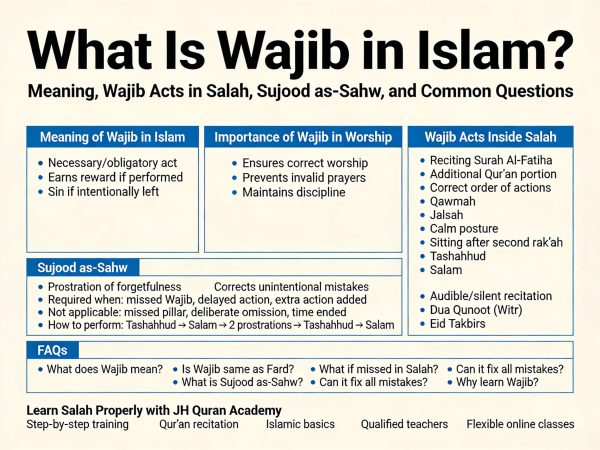
Meaning of Wajib in Islam
The term Wajib (واجب) means necessary or obligatory. In Islamic law, it refers to an action that must be performed because it is required by Islamic teachings.
- Performing a Wajib act earns reward
- Intentionally leaving a Wajib act results in sin
- Neglecting a Wajib may affect the correctness or completion of worship
Understanding Wajib helps Muslims perform acts of worship properly and avoid errors.
Importance of Wajib in Worship
Wajib acts play a key role because they:
-
Ensure the correct performance of worship, so every act is accepted and meaningful.
-
Prevent invalid or incomplete prayers, thereby safeguarding your spiritual practice.
-
Maintain discipline and attentiveness, which strengthens focus and devotion.
-
Protect Muslims from repeated mistakes, helping you progress with confidence in your faith.
Learning Wajib rulings is essential for anyone who wants to worship with certainty and peace of mind.
Wajib Acts Inside Salah (Prayer)
In addition to the essential pillars of prayer, there are certain Wajib acts performed within Salah. These acts must be observed carefully. If a Wajib act is missed unintentionally, there is a prescribed way to correct it. However, deliberately leaving a Wajib act requires repeating the prayer.
Complete List of Wajib Acts Inside Salah
- Reciting Surah Al-Fatiha
- Reciting an additional portion of the Qur’an after Al-Fatiha
- Reciting Al-Fatiha before the additional Qur’anic portion
- Maintaining the correct order of prayer actions
- Standing upright after bowing (Qawmah)
- Sitting between the two prostrations (Jalsah)
- Performing prayer with calmness and stillness (proper posture and balance)
- Sitting after the second rak‘ah in prayers of three or four rak‘ahs
- Reciting Tashahhud in both sittings
- Ending the prayer correctly with Salam
- Observing audible recitation where required
- Observing silent recitation where required
- Reciting Dua Qunoot in the Witr prayer
- Saying the additional Takbirs in Eid prayers
These actions complete the structure of Salah and must be learned carefully.
What Is Sujood as-Sahw?
Sujood as-Sahw means the prostration of forgetfulness. It consists of two prostrations performed at the end of the prayer to correct unintentional mistakes.
It is an act of mercy that allows minor errors in prayer to be repaired without repeating the entire Salah.
When Is Sujood as-Sahw Required?
Sujood as-Sahw is required when:
- A Wajib act is forgotten unintentionally
- A required action is delayed due to forgetfulness
- An extra action is added unintentionally
When Sujood as-Sahw Does Not Apply
- If an essential pillar of prayer is missed
- If a Wajib act is deliberately omitted
- If the prayer time ends before correction
In such cases, the prayer must be repeated.
How to Perform Sujood as-Sahw
-
-
First, sit in the final sitting position and recite the Tashahhud.
-
Then, say Salam once.
-
After that, perform two prostrations, just like the regular sajdah.
-
Next, sit again and recite the Tashahhud.
-
Finally, end the prayer properly by saying Salam.
-
Conclusion
Understanding Wajib in Islam, especially Wajib acts inside Salah and the rules of Sujood as-Sahw, is essential for every Muslim. These rulings help maintain the correctness of worship while allowing flexibility for human forgetfulness.
Learning these principles protects prayer, strengthens faith, and improves spiritual discipline.
Learn Salah Properly with JH Quran Academy
If you want to learn Salah correctly, understand Islamic rulings clearly, and gain confidence in your worship, then JH Quran Academy offers the following:
-
Step-by-step Salah training, ensuring you master each aspect gradually.
-
Qur’an recitation with Tajweed, so that you can read beautifully and accurately.
-
Islamic basics for beginners and advanced students, providing knowledge suitable for every level.
-
Qualified and experienced teachers, who guide you with expertise and care.
-
Flexible online classes for all ages, making it convenient for everyone to join.
Whether you are starting from scratch or correcting past mistakes, JH Quran Academy provides structured guidance in a supportive learning environment.
Enroll today and strengthen your connection with the Qur’an and Salah through authentic learning.
Frequently Asked Questions (FAQs)
Wajib refers to an obligatory act that must be performed. Leaving it intentionally is sinful.
Both are obligatory, but they differ in legal consequences when missed.
If missed unintentionally, it can be corrected. If missed intentionally, the prayer must be repeated.
It is the prostration of forgetfulness performed to correct unintentional mistakes in prayer.
No. It only corrects unintentional mistakes related to Wajib acts.
It helps ensure valid worship, reduces confusion, and increases confidence in prayer.