

Introduction: What Is Iman in Islam?
In Islam, Iman (faith) is the cornerstone of a Muslim’s belief and practice. It defines a person’s relationship with Allah ﷻ and outlines the unseen elements of belief that every Muslim must accept. Two important declarations that summarize these beliefs are:
- Iman-e-Mufassal (Detailed Declaration of Faith)
- Iman-e-Mujmal (Concise Declaration of Faith)
These are taught as part of foundational Islamic education and are essential for every Muslim.
What Is Iman-e-Mufassal? (Detailed Faith)
Meaning:
The term “Iman-e-Mufassal” translates to “The Detailed Faith”. It lists the Six Articles of Faith as mentioned in the Qur’an and Hadith.
Arabic Text:
آمَنتُ بِاللّٰہِ وَمَلٰئِکَتِہٖ وَکُتُبِہٖ وَرُسُلِہٖ وَالْیَوْمِ الْآخِرِ وَالْقَدْرِ خَیْرِہٖ وَشَرِّہٖ مِنَ اللّٰہِ تَعَالٰی وَالْبَعْثِ بَعْدَ الْمَوْتِ
English Translation:
I believe in Allah, His angels, His books, His messengers, the Last Day, and in divine destiny (its good and bad) from Allah Almighty, and in resurrection after death.
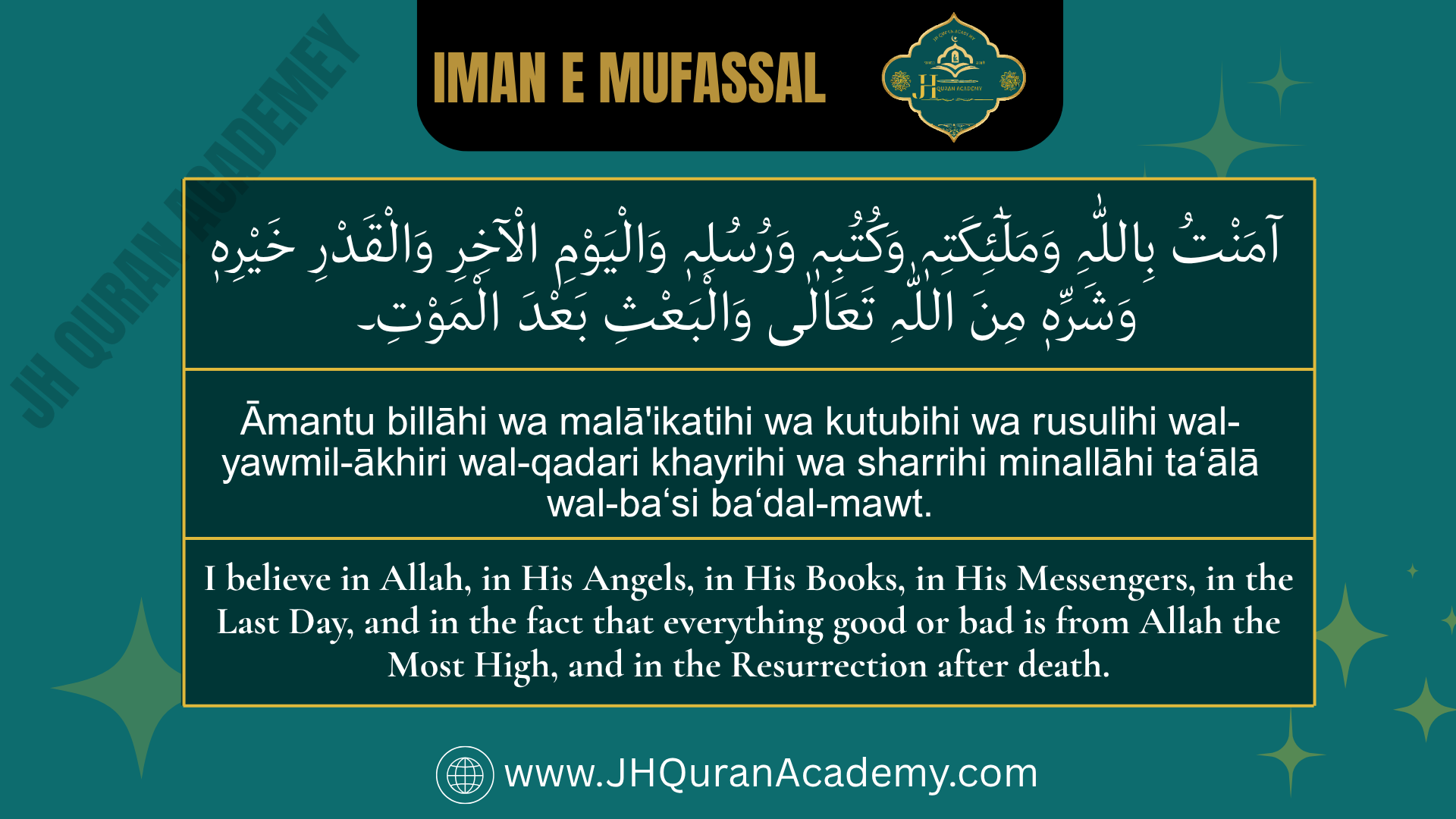
The Six Articles of Faith in Iman-e-Mufassal
According to the Hadith of Jibreel, the six pillars of Iman are:
- Belief in Allah – The One and Only God.
- Belief in Angels – Created beings who carry out Allah’s commands.
- Belief in Divine Books – Including the Qur’an, Torah, Injil, Zabur.
- Belief in Prophets – From Adam (AS) to Prophet Muhammad ﷺ.
- Belief in the Last Day (Judgment Day) – When all will be held accountable.
- Belief in Qadr (Divine Decree) – Both good and bad are from Allah, and belief in life after death.
What Is Iman-e-Mujmal? (Concise Faith)
Meaning:
Iman-e-Mujmal means the “Summarized or Concise Faith.” It reflects a Muslim’s full submission to Allah and acceptance of all His commands.
Arabic Text:
اٰمَنْتُ بِاللہِ کَمَا ھُوَ بِاَسْمَآئِہٖ وَصِفَاتِہٖ وَقَبِلْتُ جَمِیْعَ اَحْکَامِہٖ اِقْرَارٌم بِاللِّسَانِ وَتَصْدِیْقٌ بِالْقَلْبِ
English Translation:
I have faith in Allah as He is, with all His names and attributes, and I accept all His commands with my tongue and affirm them with my heart.
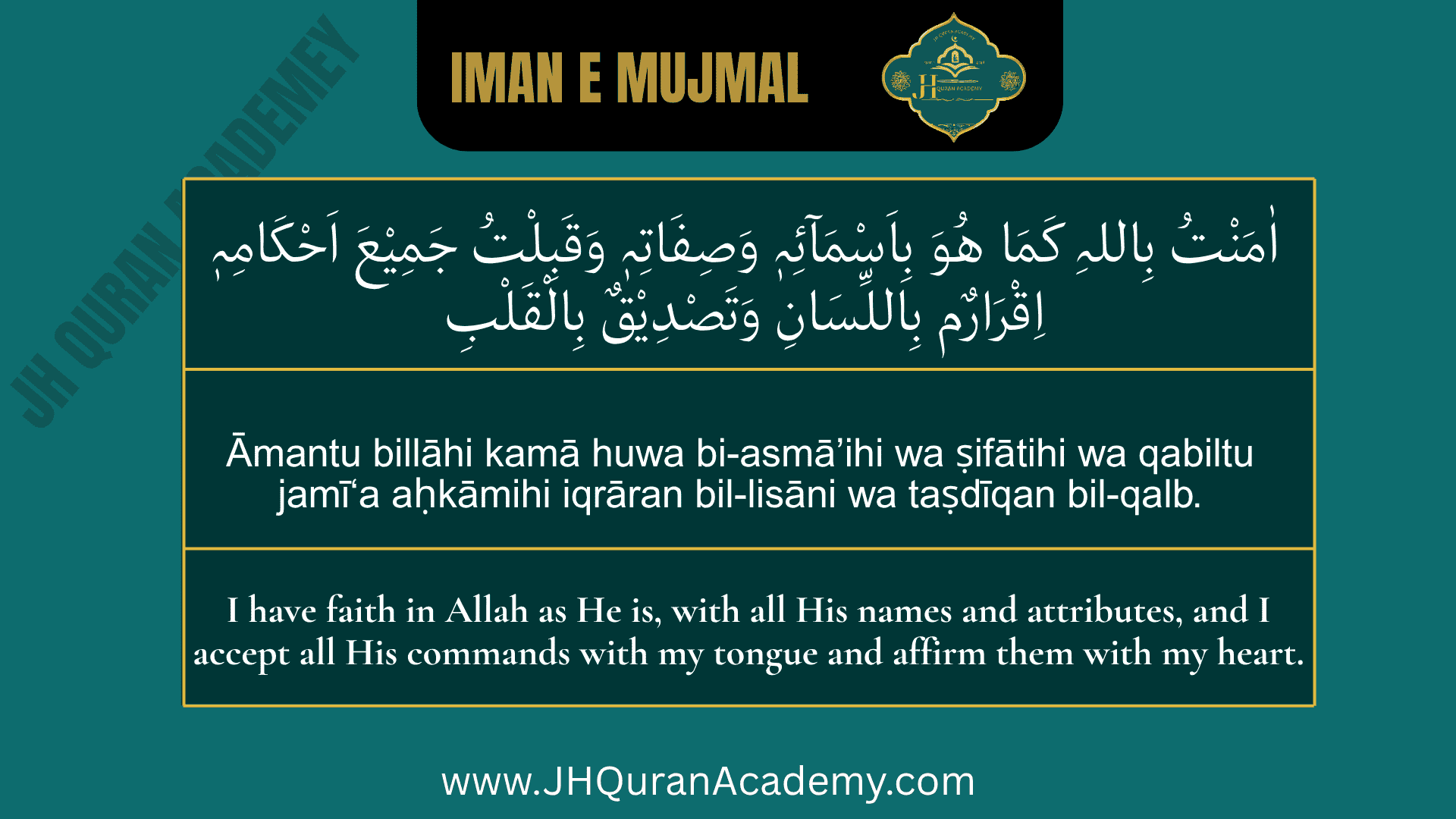
Hadith Source for Iman-e-Mufassal
The basis for Iman-e-Mufassal comes from the famous Hadith of Jibreel, narrated in:
- Sahih Muslim, Book 1, Hadith 1
- Sahih Bukhari, Book of Iman, Hadith 50
In this hadith, the Prophet ﷺ was asked about Islam, Iman, and Ihsan by Angel Jibreel (AS), who appeared in the form of a man. The Prophet ﷺ listed the six pillars of faith, which are the foundation of Iman-e-Mufassal.
Are Iman-e-Mufassal and Iman-e-Mujmal from the Same Hadith?
No. They are not both from a single Hadith.
- Iman-e-Mufassal is derived from authentic Hadith (Hadith of Jibreel).
- Iman-e-Mujmal is a summary compiled by scholars based on Qur’anic teachings and Hadith.
Difference Between Iman and Islam Summary:
- Iman (Faith) refers to the internal belief and conviction in the heart, such as belief in Allah, angels, prophets, revealed books, Day of Judgment, and divine destiny.
- Islam (Submission) refers to the outward actions and practices, such as praying (Salah), fasting (Sawm), giving charity (Zakat), and performing Hajj.
In short, Iman is about inner belief, while Islam is about outward practice. A complete Muslim should have both Iman and Islam together.
Importance of Iman-e-Mufassal and Iman-e-Mujmal
These two declarations:
- Help Muslims understand and memorize the core Islamic beliefs.
- Are taught during early Islamic education.
- Serve as a reminder to strengthen faith.
- Help in renewing one’s Iman regularly.
- Reflect the responsibilities of a Muslim toward Allah ﷻ.
Learn With JH Quran Academy – Your Gateway to Islamic Knowledge
At JH Quran Academy, we focus on helping students of all ages understand and memorize the foundations of Islam, including:
- Iman-e-Mufassal and Iman-e-Mujmal
- The Six Kalimas
- Basic Duas
- Quran with Tajweed
- Islamic Manners and more
Learn with certified Islamic teachers in a comfortable and flexible online learning environment.
Enroll today and start your journey of Islamic learning with JH Quran Academy.
Conclusion
Iman-e-Mufassal and Iman-e-Mujmal are not just statements; they are comprehensive summaries of the Islamic faith. Understanding and reciting them strengthens the Muslim identity and nurtures a sincere relationship with Allah ﷻ.
Whether you’re a parent, a student, or a new Muslim—learning these declarations is the first step in connecting with the divine message of Islam.